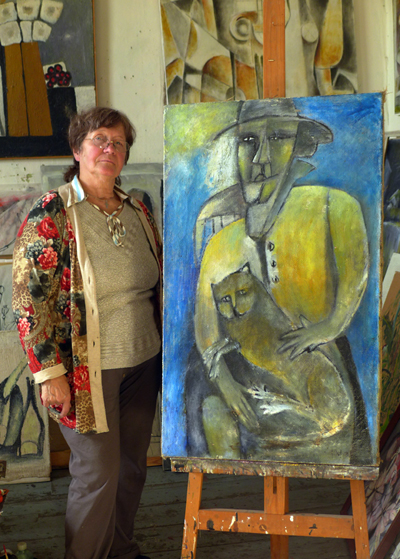
Julia Nikolaevna Ivanova (1944–2019)
A leading painter of the Leningrad nonconformist generation whose canvases transform everyday life into enduring painterly architecture.
Vision, Form, and Pigment
Julia Nikolaevna Ivanova (February 5, 1944 – 2019) belonged to the remarkable generation of independent artists who shaped unofficial cultural life in Leningrad during the 1970s and 1980s and carried its painterly rigor into post-Soviet St. Petersburg. Born in wartime evacuation near Khabarovsk in the Russian Far East, she spent her childhood in Pechory before her family settled near Leningrad in 1957.
After early training in landscape architecture at the Leningrad Green Building College, Ivanova found her true vocation in 1968 when she began studying painting under the renowned nonconformist master Solomon Rossin. From Rossin’s studio she absorbed an uncompromising devotion to painting as a spiritual calling, before completing her formal higher education at the V. I. Mukhina Leningrad Higher School of Industrial Art (1970–1977).
Throughout the 1980s, Ivanova was an active participant in the landmark exhibitions of TEII (the Fellowship of Experimental Fine Arts)—the principal association of Leningrad’s nonconformist painters—before joining the Union of Artists in 1988. Working free of ideological or commercial formulas, she synthesized lessons of early Russian modernism, Cubist spatial construction, and expressive colorism into a deeply individual idiom.
In her celebrated still lifes, familiar objects from her studio—violins, mandolins, earthen jugs, samovars, lamps, dried fish, and exuberant summer flowers—acquire a monumental, metaphysical weight. Built up in tactile layers of warm ochre, umber, deep ultramarine, and earthen red, forms seem to grow organically from within the canvas. Her self-portraits and figure paintings are equally unmistakable: candid, psychologically resonant meditations on solitude, endurance, and empathy, frequently shared with the cats and animals she loved. In her cityscapes, the embankments, canals, and cathedrals of St. Petersburg bend and pulse with an inner musical rhythm.
Julia Ivanova worked in her St. Petersburg studio until the end of her life in 2019, leaving behind a cohesive and luminous body of oil paintings, temperas, and works on paper that continue to be exhibited in major museum retrospectives.
“There are still souls in Russia who believe that art is a Temple and its air is sacred. Julia Ivanova is just such an artist… a star.”— Solomon Rossin
Biographical Timeline
-
1944
Born on February 5 in wartime evacuation near Khabarovsk.
-
1947–1957
Lived in Pechory (Pskov region), whose ancient monastery walls and northern landscape left a lasting impression.
-
1957
Moved with her family to Gatchina, near Leningrad.
-
1958–1962
Studied “Planning of Parks and Gardens” at the Green Building College, Leningrad.
-
1965
Birth of her daughter.
-
1968–1970
Studied painting under the guidance of Solomon Rossin.
-
1970–1977
Studied in the Department of Interior and Equipment at the V. I. Mukhina Leningrad Higher School of Industrial Art (now the Stieglitz Academy).
-
1978
Debut in public exhibitions at the Regional Exhibition of the Leningrad Union of Artists.
-
1979
Birth of her son.
-
1980–1987
Taught painting at an art studio in Leningrad while developing her mature still-life style.
-
1983–1989
Exhibited regularly with TEII (the Fellowship of Experimental Fine Arts), the landmark independent association of Leningrad nonconformist artists.
-
1988
Admitted to the Leningrad branch of the Union of Artists.
First international exhibition in Berkeley, California, USA.
-
1989
First solo exhibition, White Still Life, at the Sverdlov House of Culture, Leningrad; exhibited in Paris, France.
-
1990s–2010s
Worked in her St. Petersburg studio, participating in major exhibitions at the “Manezh” Central Exhibition Hall (St. Petersburg), the Central House of Artists (Moscow), and galleries in Finland, Germany, France, Italy, and the United States.
-
2019
Passed away in St. Petersburg at the age of seventy-five.
-
2024
Honored with the retrospective solo exhibition Growing Out of Form («Растущая из формы») at the Museum of Art of St. Petersburg of the 20th–21st Centuries (MISP).